Sunday, October 30, 2011

One Flew Over the Cuckoo’s Nest


AFI Top 100 Ranking: 33
Year: 1975
Writer: Lawrence Hauben, Bo Goldman (adaptation), Ken Kesey (novel)
Director: Milos Forman
Star: Jack Nicholson, Louise Fletcher, Brad Dourif

“One Flew Over the Cuckoo’s Nest” is one of those movies you admire so much in the broad strokes. I hadn’t seen the movie in years, and my memory had forced all the odd edges and annoyances out of the picture, and I remembered the film as a masterpiece. I remembered the fantastic moment where Nurse Ratched demands her soiled hat back. I remembered the Chief speaking for the first time. I remembered Nicholson begging the other patients in the ward to raise their hands so he can watch baseball. And those scenes are still great. But, looking at the movie today, I can’t help but be a little let down.

Perhaps it’s because those aforementioned scenes (and many others) are so good, you want to like the rest of the movie more than it merits. Or perhaps it’s because the movie touches greatness so often you can’t help but notice its failures. Maybe I’ve just become more cynical. Maybe movies have just become more cynical. Maybe it’s a little of all of the above.

It all centers on McMurphy (Jack Nicholson, who is brilliant), who was in prison but gets a transfer to a mental institution to, ostensibly, relax and take it easy for a few months before he’s released. Little does he know that the ward is ruled with an iron fist by Nurse Ratched (Louise Fletcher, every bit as good as Nicholson). The movie becomes anti-establishment, with McMurphy fighting against “the man” and introducing the other patients to sex, drugs and alcohol.

McMurphy is such a defining character that we’ve stopped thinking of him as a “character” and simply believe that he is Nicholson. Most actors hate the word “effortless” to describe a performance because so much effort is put into any good one, but that word describes Nicholson in this film. And Fletcher’s quiet reserve serves as the perfect compliment to Nicholson’s unhinged nature. When the relationship becomes explosive, it’s resonant because the moment has been built and paced beautifully over the film.

The rest of the patients in the ward are portrayed well by a great slew of character actors, including Danny DeVito, Will Sampson, William Redfield, Christopher Lloyd, Sydney Lassick and Brad Dourif. They know when to go subtle and when to go over-the-top, and I feel like their performances are the real reason we find ourselves laughing “with” these characters, not laughing “at” them.

The highest compliment I can give the screenplay by Lawrence Hauben and Bo Goldman is that the dialogue doesn’t seem like dialogue. The entire movie has the feel of improvisation, which might be the toughest thing a writer can pull off successfully.

The best scene the movie comes when Nurse Ratched (and the audience) realizes that she’s lost control. No, not the late night orgy of booze and boobs, this comes earlier. They are having group counseling and McMurphy is livid because he’s realized he’ll have to remain an inmate until Ratched says he’s free to go. First, one of the patients simply asks why their bedrooms are locked during the day, and then another (played by Lassick) begins screaming for his cigarettes. Ratched remains stone-faced as the screaming turns into anarchy and the anarchy turns to violence…resulting in Lassick’s character, McMurphy and the Chief (Sampson) being taken to electroshock therapy. The scene is probably almost seven minutes and the direction, editing, acting and slow build of tension makes the entire thing crackle with energy. I look at those moments and think just how amazing the movie could be if every scene was as true as this one.

But then there are the problems.

First and foremost, it becomes clear that McMurphy believes (and the movie does as well) that he can cure these men through the use of masculinity. Just shove enough alcohol (never mind what side effects it might create for the drugs they are taking) in their mouths and enough breasts in their faces and they can recover. These men are mentally ill. The writers try (but don’t succeed) in side-stepping this by stating that most of the patients are there voluntarily, so obviously they aren’t crazy, right? Right? Yes, McMurphy metaphorically and mentally “frees” the Chief, but what of the others? The ones with real issues. Billy’s death is just as much McMurphy’s fault as Nurse Ratched’s, but it’s easier to overlook that because this is an anti-establishment story.

In fact, there’s an entirely different interpretation of the movie one could see, one where Ratched is the hero and McMurphy is the villain. She is, after all, just doing her job and he’s putting these guys in harm’s way every chance he gets. In this version, McMurphy gets what he deserves at the end and sanity is restored. I’d normally call a movie working just as well under several interpretations a great thing, but this movie is so obviously on McMurphy’s side, this can only be seen as a fault.

Also a major issue is the blatant misogynistic spin. Ratched has removed all semblances of femininity from herself, and as a result is called a “cunt” and “bitch” early and often by McMurphy. Her assistant barely has three lines. Dourif’s character has issues with his mother and ex-girlfriend, and Redfield’s character loathes his wife. The only women seen in a good light are the whores who go sailing with the boys and sneak the booze into the hospital.

And then there’s the little fact that the (I’m guessing) 40ish-year-old McMurphy was in prison because he raped a 15-year-old girl. This is actual dialogue: “She was very willing, if you know what I mean. I practically had to take to sewing my pants shut. Between you and me, she might have been 15 but, when you get that little red beaver right up there in front of you, I don't think it's crazy at all…and I don't think you do either.”

We’re supposed to cheer for this guy. The movie basically forgets this little exchange happened five minutes later, so I guess they figure we should as well?

These are all major, major problems that prevent the movie from working as it should. But it’s so much easier to forget. To forgive the movie for its issues. To just focus on Nicholson and Fletcher and cheer when the Chief breaks that window and embraces his newfound strength. Good luck with that.

My Score (out of 5): ***

Saturday, October 29, 2011

Dr. Strangelove or: How I Learned To Stop Worrying and Love the Bomb


AFI Top 100 Ranking: 39
Year: 1964
Writer: Stanley Kubrick, Terry Southern (adaptation), Peter George (novel)
Director: Stanley Kubrick
Star: Peter Sellers, George C. Scott, Slim Pickins

The biggest joke in “Dr. Strangelove” is that is would have made one hell of a good thriller. In fact, it did. Ever see Sidney Lumet’s “Fail Safe”? Of course, until its third act, “Dr. Strangelove” plays its situation completely straight. No one winks at the audience. The actors twitch. A lot. But they never wink.

The plot involves a crazed General named Jack D. Ripper (Sterling Hayden) implementing Wing Attack Plan R (for Robert), in which all the American nuclear bombers go incommunicado and attack Russia. Ripper’s aide (Peter Sellers) desperately struggles to learn a code that will bring communication back to the bombers. Meanwhile, the President (Sellers again) convenes all his important Generals and severe-looking friends in the War Room to try and prevent the disaster. Most notable among the attendees is General Turgidson (George C. Scott), who chews a lot of gum and isn’t beating himself up over this little slip up, and Dr. Strangelove himself (Sellers a third time), a former Nazi with a hand that has a mind of its own. Oh, and we’re also following one of the bombers piloted by King Kong (Slim Pickins) as it approaches its Russian target. Personally, I wish the Kong role was a fourth for Sellers, but what can you do?

Writers Stanley Kubrick (also the director) and Terry Southern are brilliant in the way they slowly build their jokes by grounding them first in reality and then logically escalating them a step at a time until we are lost in the hilarity of it all. One of the best gags is when Ripper’s aide desperately needs to make a call to the President. The red phone in Ripper’s office has been destroyed. So has the regular phone. Good thing there’s a pay-phone in the hallway. But, crap, Sellers doesn’t have enough change. Can he call the President collect? Nope. Does a nearby soldier have change? Of course not, why would a soldier carry coins into battle? Sellers finally begs the soldier to fire into a Coke machine, and then they get into the ethics of destroying property of the Coke-a-Cola corporation. The solider finally concedes, but if Sellers doesn’t get in contact with the President there will be hell to pay. And then there’s the beautiful visual gag of Coke spurting from the machine all over the soldier’s face. The entire affair is underlined by the suspense that, if Sellers doesn’t make that call, the entire world will be plunged into a nuclear winter. It’s brilliant.

There are many genuinely funny scenes just like this peppered all around “Dr. Strangelove,” but I must admit that some of these jokes and payoffs just don’t land as they once did. It’s a shame because other filmmakers have ripped off many of the jokes so often and in such a literal fashion that they can’t help but lose some of their power. Look at the moment where Scott’s character takes a personal call with his secretary/whore in the war room. How many variations on this moment have we seen in film and on television? Or the scene where the secretary/whore carries on a conversation on the phone between two men by screaming at one in the bathroom?

Ah well, when the movie is at its best, it’s still maniacally funny. “Gentlemen, you can’t fight in here, it’s the War Room!” is right up there with “Nobody’s perfect” or “Show me the money!” in the echelon of all-time-best comedic one-liners.

Sellers is great in his three roles. Dr. Strangelove is, of course, the showiest, and I’m guessing whenever they show a clip of Sellers in the movie, this is the first character they focus on. But, for my money, his “straight man” performances as the President and Ripper’s aide Mandrake are even better. Mandrake is probably my favorite, but that’s because the character gets my favorite extended gag (the aforementioned Coke machine sequence) in the movie. Scott’s performance is purposefully over the top, as if he’s playing to the third tier of a theatre without realizing Kubrick is filming in close-up. The result is splendid.

I must say that I think there is a major structural error in the movie’s third act. As Kong rides the bomb down to the ground, screaming in glee the entire time, the movie reaches its maniacal high point. But then, for some unknown reason, we move back to the War Room for more talk and plans of moving into mines for a hundred years or so. The scene is funny, but why is it here? Why couldn’t this scene have been moves to before the bombing moment, that way we are on a high when the film cuts to the “We’ll Meet Again” and the montage of bombs going off. The scene feels unnecessary as it is, and hurts the pacing of the final act.

Of course I make my complaints in the full knowledge that this movie getting made at all was miraculous, and that Kubrick and Southern actually pulling off making a nuclear disaster funny was nearly impossible. “Dr. Strangelove” is one of those once-in-a-generation features that breaks all the rules in such a way that they can never be broken in the same way again.

It turns out Kubrick was very good at this “breaking the rules” thing – in addition to this movie he similarly rewrote what we thought we knew about film with “2001: A Space Odyssey” (also in the AFI Top 100), “Barry Lyndon” and “The Shining.” This will be my final Kubrick article for this series (I’ve previously written on “Spartacus,” “A Clockwork Orange” and “2001: A Space Odyssey”), and I must say that even though his work has never emotionally engaged me on a level Chaplin, Hitchcock, Wilder, Spielberg or Huston do, I really admire what his movies aspire to be and love his technical expertise. They are all imperfect, sure, but Kubrick is unafraid to take us places and do things with his films other directors would never attempt to try.

My Score (out of 5): ****

Thursday, October 20, 2011

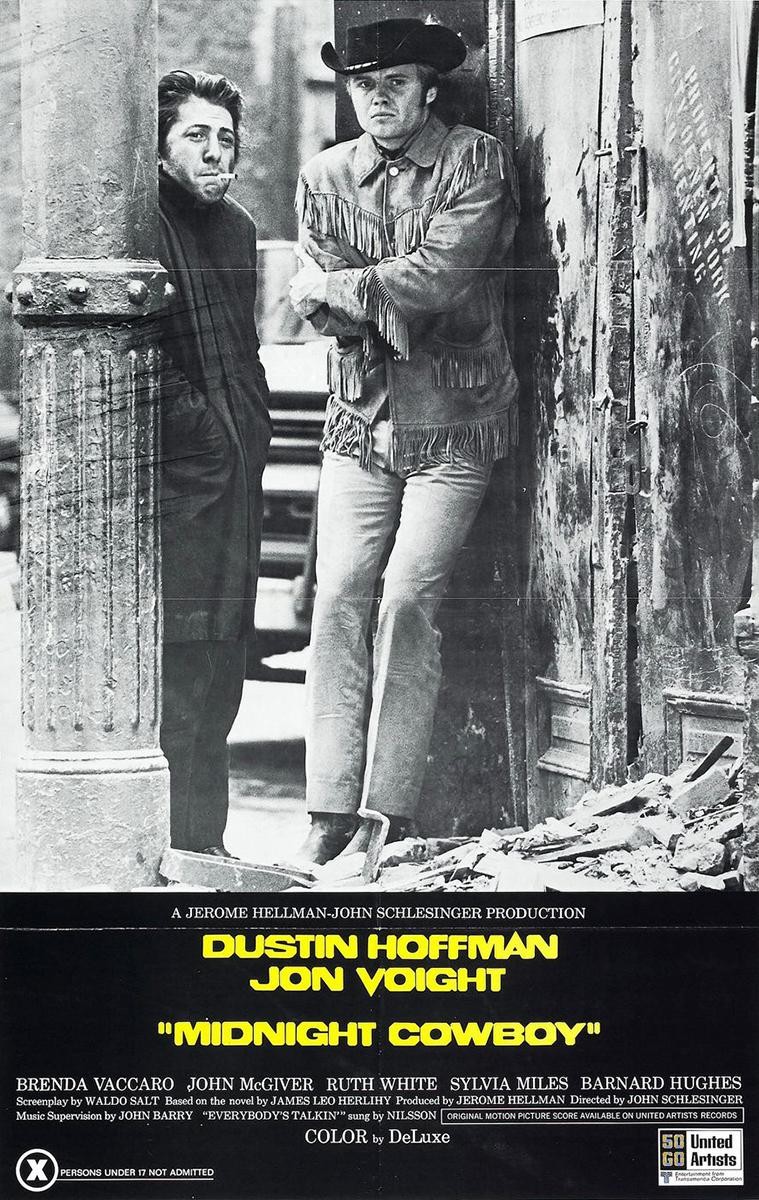
Midnight Cowboy


AFI Top 100 Ranking: 43
Year: 1969
Writer: Waldo Salt (adaptation), James Leo Herlihy (novel)
Director: John Schlesinger
Star: Dustin Hoffman, Jon Voight

When I finished watching “Midnight Cowboy” I was surprised by how little it moved me. It had two engaging characters at its forefront and a few genuinely engaging moments, but so much of its edge has dulled and so many of the things that (I presume) were once groundbreaking are now eye-rolling and cliché.

Jon Voight stars as Joe Buck, the “cowboy” of the title. And yes, his name couldn’t be more on-the-nose. He hops a bus from Texas to NYC with the intention of being a well-paid, well-laid hustler, but the Big Apple has other plans for him. These early sequences on the bus and on the streets of the city take their time and give you a real feel for Joe’s character. There’s also a very funny sequence where a woman picks up Joe off the street and sleeps with him. The apartment she’s in is swanky and rich, but by the end of the night he feels so bad for her that he ends up paying her. Whoops.

There seems to only be two versions of New York City in film: The fairy tale, perfectly-lit version where the moon is always in frame and trees on the street are lit with Christmas lights…and the version where it seems like the production designers have smeared their own feces everywhere just before the cameras rolled. Director John Schlesinger, his cinematographer Adam Holender and editor Hugh A. Robertson have gone out of their way to turn New York City into a dingy, dirty (dirty!) character all its own. The signs Joe steps near seem to mimic his state of mind, and every surface of every room is covered in grime. Anyway, the cutting to the city is fine and interesting while Joe is getting acclimated to the city, but as the film wears on, my nerves wore thin, to the point where a glowing sun electric billboard slowly fading out during an emotional low point caused me to laugh.

Into Joe’s world hobbles Ratso Rizzo (Dustin Hoffman). Not the Muppet, that’s Rizzo the Rat. Joe’s never seen anyone like Rizzo before, and though they butt heads early and often, Rizzo eventually invites Joe to share his shack of an apartment, where they live together and become inseparable. He also has one or more of the following illnesses, so feel free to mix and match: polio, tuberculosis, cancer and/or pneumonia. Like Voight, Hoffman is tremendous in the role, making the viewer really care about the poor guy’s plight without making him a stereotype.

The friendship between these two characters is the best thing about the film and, really, the one part of the movie that hasn’t aged. In a few short scenes, writer Waldo Salt establishes the characters perfectly and there’s a real evolution of feelings and friendship between the characters as the movie progresses that resonates without becoming trite or obvious. When Rizzo tearfully tells Joe that he can no longer walk, our hearts break for both of them. Today it’s much easier to read into the relationship’s homosexual undertones (especially considering the scene where Joe abandons Rizzo to be with a woman and then cannot get an erection) but, to me, there’s a real beauty to the simplicity of two men falling in love without “falling in love.” Ah well, it works just as well both ways, and the ability of the actors to toe the line without being more blatant makes the movie all the more interesting.

After writing that last paragraph, I really wish I could say the rest of the movie was as special as the main characters are, but almost everything else stumbles badly. First, there are those horrible “Screenwriting 101” flashbacks to Joe’s life back in Texas that allude to horrible memories with his grandmother and first love. Even worse is the fantasy sequence where Rizzo imagines himself a gambling king in Florida with a bunch of wheelchair-bound elderly women. Oy. How these moments made the final cut is beyond me, especially considering that they undercut and water down some fairly good sequences they are injected into. Look at the scene where Joe is desperate enough to hustle a young guy in the movie theatre for a real missed opportunity.

And don’t even get me started on the Andy Warhol-inspired psychedelic party Rizzo and Joe find themselves attending.

The movie implodes the moment Joe loads Rizzo on a bus to Florida for the film’s denouement. Even before the bus took off I would have bet any money that Rizzo wouldn’t make it to his final destination…and wouldn’t you know it? He dies miles before he reaches Miami. Such obvious writing that basically does everything but reach out of the screen and forcibly extract the tears from your eyes. How can you emotionally engage in something that tiresome? Yes, I know variations on this have been done thousands of times, in everything from “One Way Passage” to “Battlestar Galactica” to that bittersweet scene that closes “The Age of Innocence.” And yet those works earned their endings. Here the truer thing would have been to keep our characters in the city to face their endings head on.

What makes all this all the more frustrating is because there was so much potential, and every time the film touches greatness it’s undercut by such sloppy storytelling. “Midnight Cowboy” should have been a masterpiece and could have been one. If only…

My Score (out of 5): **1/2

Saturday, October 8, 2011

Goodfellas


AFI Top 100 Ranking: 92
Year: 1990
Writer: Martin Scorsese, Nicholas Pileggi (adaptation), Nicholas Pileggi (book)
Director: Martin Scorsese
Star: Ray Liotta, Robert De Niro, Joe Pesci

For any film to be successful, it must transport the viewer into the world of the protagonist, however real or fanciful that may be. We think of this rule more for science fiction or horror films, but “Goodfellas” may just be the movie that gives its viewer the most immersive experience in film history. It’s not about the mafia, it is the mafia. Unflinchingly.

This is the story of Henry Hill (Ray Liotta as an adult, Christopher Serrone as a teenager), his life in the mafia and ultimate betrayal of those he once loved to spare himself. As a kid, he looked across the street at a store the mafia owned and, as soon as he can, he nabs a part-time job. One thing leads to another and before we know it Henry is exploding cars for his buddies and taking as much off the top as he wants. When we first see Henry as an adult, we are struck by his laugh. The only way I can describe it here is violent. That’s fitting.

Henry describes, in voiceover, everything his does and the practices of his friends in the mafia in a straightforward way. It might be repugnant to the viewer, but to him it’s perfectly logical. We might not agree with it but, hey, if it works for him. And it does work for him for a very long while. He makes more money than one could imagine, marries a beauty (Lorraine Bracco), nabs several mistresses and treats his friends like “family,” and yes, I did mean that as a pun. Of course he’ll never really be an insider…he’ll never be “made”…because he’s only half Sicilian, but his charisma and sure business sense almost makes up for that blood shortcoming.

Life continues to get bigger and better for Henry. Sure, he goes to jail, but he’s treated like a king there and learns a new way to slice garlic that I really should try sometime. Yes, his wife holds a gun to his face because she knows he’s cheating on her, but she’s never actually going to leave him. They move into a house where everything is so expensive and over-the-top you just know it’s the ugliest place in the city. We also meet many of the people Henry works with, most notably Tommy (Joe Pesci) and James (Robert De Niro). And there’s food. Lots and lots of food. The rest of the world, meaning the large majority that has no connection to the mafia, doesn’t exist to him or his family.

Writers Martin Scorsese (also the director) and Nicholas Pileggi just dive right into the world and don’t look back. They have a lot of fun with the mythos of the mafia and what our expectations for this type of movie are. Early in the film Henry says Tommy is “funny” and Tommy goes on an almost violent tirade against him, but it was all just a gag…until Tommy does physically beat someone moments later. Tommy’s girlfriend boasts “He’s so jealous. He said if I even looked at another guy he’d kill me.” By this point the viewer is thinking “Sister, you don’t know the half of it.” One of the movie’s high points is when Henry’s wife Karen hangs out with all the other mafia wives and observes how similar they all are in their look and speech. It’s funny but, at the same time, very sad, especially since Karen becomes one of those women she mocks soon after.

Violence is always there in “Goodfellas.” It opens with a bloody man being stabbed savagely and shot repeatedly in a trunk, even though logic tells us that when so many gunshots are fired into the trunk of a car at least one would break through into the gas tank and explode the thing. Scorsese shows us Henry’s first encounter with mafia violence when a man comes to the store Henry works with a shot hand. He’s told moments later that he shouldn’t have wasted all those aprons he used to stop the man’s bleeding. When the violence comes, it’s usually in quick spurts that have all the more impact because of their briefness. These moments happen more and more often as the film develops.

Henry’s great life lasts for as long as it can…and then it’s over with the snap of someone’s fingers. It’s hard to imagine that Henry couldn’t have expected this (he always keeps a brick of cocaine on hand in his home for emergencies, after all), especially since no mention is made of what the retirement plan from the mafia was. But his sins come back to bite him in the butt during a brilliantly staged day where Henry drives back and forth to many of his friends’ and family’s homes in a haze of cocaine, all the while followed by a helicopter. We don’t feel bad for him when he finally loses everything. How can we? And his punishment…an endless life in the suburbs, seems more fitting than a bullet to the brain lesser filmmakers might have ended the film with.

Though Pesci’s unhinged performance is the best of the ensemble, the most interesting performance is indeed Liotta. Thank God for the voice-over, because it helps to steer us through the waves of Liotta’s character. When we first meet him he’s charming enough and handsome enough to get away with just about anything he wants to, and he seems to be channeling a lot of John Travolta’s charm, especially in the early scenes with Karen. But as he ages and gets oilier and less handsome, you begin to see the cracks. He needs that cocaine and those mistresses because they tell him lies that he’s the man he once was. Liotta goes big a few times, wonderfully over the top, but that only underlines as good as he is at underplaying the rest of his work.

Scorsese plays some camera tricks and, with his cinematographer Michael Ballhaus, presents us with some tremendous long takes. Most of them work, though the many freeze-frames in the first act don’t hold up as well as the rest of the movie. Today they distract from instead of underlining what we see. However, that’s a small complaint when everything else around it is pitch-perfect.

Scorsese and Pileggi envelop the viewer so well into the world that you can’t help but lose control of your moral compass. I never “liked” Henry. Or Karen. Or Tommy. But I did find myself caring deeply for their world and involved in their fates. If a film’s creators can make me that invested in something so despicable, they’ve done the seemingly impossible, and the result is a masterpiece.

My Score (out of 5): *****

Wednesday, August 31, 2011

The Deer Hunter


AFI Top 100 Ranking: 53
Year: 1978
Writer: Deric Washburn (screenplay), Michael Cimino, Deric Washburn, Michael Cimino, Louis Garfinkle (story)
Director: Michael Cimino
Star: Robert De Niro, Christopher Walken, Meryl Streep

“The Deer Hunter” has some good things in it, but the overall effect I got out of it was indifference. When I realized that the three act structure of the film would follow a character named Michael (Robert De Niro) before his tour in the Vietnam, during the tour and then the emotional aftermath when he returns home, I thought it was refreshing and couldn’t wait to dive in. Then, as the movie rolled on (and on (and on))) I began to realize that the film’s messages (the ones that came out when it wasn’t trying to be overly ambiguous) were nothing we hadn’t seen told better in other films. Ultimately, the movie feels ambitious, but in the sense that it’s overindulgent, overlong and overcooked.

The film’s first act mostly focuses on a Russian Orthodox wedding attended by Michael, his best friend Nick (Christopher Walken), the woman they both love (Meryl Streep), the groom (John Savage) and assorted drunken people. And yes, for awhile it’s very enjoyable to get such a slice of small-town life and see the joy and exhilaration of the celebration. But twenty minutes would have been fine…instead we’ve got another thirty to watch.

The main male cast are drunk for the first hour and ten minutes of the movie. I wish I was exaggerating, but I’m not. Writer Deric Washburn and director Michael Cimino try give us one of those “this is how men really behave” feelings here. But let’s be honest with ourselves, guys. This isn’t how dudes really act when they are drunk. The actions we see here and the guys’ behavior is how men wish we could act while they are drunk. Here the characters have deep, logical, insightful conversations with one another, can drive wonderfully under the influence, go hunting and actually see well enough to shoot a deer, shower each other with beer on a pool table and perfectly play the piano. In reality, these characters would probably burp, pee in the corner of a room and then pass out on the couch.

The film picks up immensely once the men get to Vietnam, reaching its high point with an incredibly tense Russian Roulette sequence and nail-biting escape and rescue. Cimino does an excellent job of staging the Russian Roulette game, surprising us by having the gun go off in shot angles we would not normally expect. And yet, even here I have reservations about how to story tackles the subject. In the first place, none of the main men die here. Yes, I know what happens to Nick later, but still, the scene would have been more powerful had one of the main characters actually shot himself here. And, in many ways, it would actually serve to further underline Nick’s PTSD and psychosis in the third act. The only characters that die are faceless characters. The movie also goes out of its way to not characterize any of the Vietnamese people, whatever side they are on. In “Platoon” this worked because they seemed more like a force…more like ghosts, but here the creators had every opportunity to take a few moments to give a little depth to them and avoided it. It’s a missed opportunity.

When the Michael character gets home, the movie slows down and acts like it’s giving us real insight into its characters and their situations. But just about everything every character does here is expected and pretty predictable. Of course Michael isn’t going to want a welcome home party. And of course he’s going to be emotionally distant from Streep’s character, who of course will latch onto him not only because she loves him, but because he is a connection to the other man she loves. And we know Michael is ultimately going to go back to get Nick, but he will not be successful.

I feel like, despite my complaints, there is insight here and there are very deep, well-acted scenes. It’s just that I’ve just seen much better interpretations of the subject matter than here. For example, “The Best Years Of Our Lives” done two generations before about WWII, is much more emotionally shattering and intuitive in its portrayal of the men coming home from the war, scarred both emotionally and physically. And for all the suspense and horror of the Russian Roulette scenes, “Platoon” is so much better at showing the real terror and uncertainty of the Vietnam war. And hell, if I want to see a bunch of guys under the influence and scared about going to war, I’ll watch “Hair.” It has a better soundtrack.

More than that, this is the first time I’ve been watching a movie on the AFI Top 100 and thought “well, the critics must have loved this.” Today it’s business as usual for studios to release films (“The Reader”) that seem tailor-made (“A Beautiful Mind”) to be nominated (“Million Dollar Baby”) for a bunch of Oscars (“The King’s Speech”), even though the content (“The Queen”) of the movies themselves (“Babel”) may not merit the attention (“The Curious Case of Benjamin Button”) they receive. That’s how I felt watching “The Deer Hunter.” Ooh, there’s the scene they shot for Streep’s Oscar reel! Oh look, an ambiguous ending that is bittersweet! Oh look, guys crying!

Look, I understand what Cimino was trying to accomplish here and I have a lot respect for what he did pull off. “The Deer Hunter” isn’t a bad movie, but it doesn’t work nearly as well as it could. It’s obvious and heavy-handed when it could have been subtle and impactful. It could have used a meat cleaver to chop off 45 minutes of fat. Sure, there were parts that were touching, and the performances of the leads are very good, but I also must say that I probably won’t remember most of the movie next month.

My Score (out of 5): **1/2

Tuesday, August 30, 2011

Forrest Gump


AFI Top 100 Ranking: 76
Year: 1994
Writer: Eric Roth (adaptation), Winston Groom (novel)
Director: Robert Zemeckis
Star: Tom Hanks, Robin Wright, Gary Sinise

There’s no way that “Forrest Gump” should work. If you told me to watch a heartwarming movie about a “simple” man who manages to be involved with almost every major event in American history from the 50s to the 80s and, in the process, reveal many of the underlying truths in our culture, I would have probably laughed in your face. And yet, here I sit, greatly admiring screenwriter Eric Roth and director Robert Zemeckis’ sprawling epic.

Perhaps one of the secrets of the movie is that it doesn’t frontload its political and moral messages. Instead, screenwriter Eric Roth engrains several simple, t-shirt-ready universal truths into the character of Forrest (played wonderfully by Tom Hanks), often from the lips of his beloved Mama (Sally Field), and repeats them often (“Stupid is as stupid Does,” “Life is like a box of chocolates, you never know what you’re gonna get.”). Through those simple phrases we get perspective on defining American events, and a surprising insight.

Over the course of the movie, Forrest involves himself in the Vietnam War, begins the Watergate scandal, is one of the first investors in Apple Computers, almost becomes a member of the Black Panthers, helps to re-open American political relations to China and inspires John Lennon’s “Imagine.” I’m only scratching the surface here, there’s plenty more he gets himself mixed up in, mostly in quirky, original, memorable ways. Miracles happen early and often in Forrest’s life, beginning with the moment that he is running from bullies and his leg braces fall off. Instead of hobbling Forrest, when they fall off they free him, and he finds he can run faster than almost anyone else. Perhaps more miracles happen to him because he has a simpler mind and bigger heart than most, or maybe it’s because he’s smart enough to recognize them as miracles instead of just luck.

Just reading that last sentence misrepresents the movie as corny, oversweetened dreck, but it’s really not. There’s plenty of dark content here, thanks to Forrest’s true love and his best friend. We like Jenny (played by Robin Wright as an adult) almost immediately upon meeting her, thanks to the fact that she’s the only person who will give Forrest the time of day. There’s a beautiful scene early on where Jenny and Forrest run into her drunk, pedophile father’s fields to hide from him and she wishes to be turned into a bird. Roth revisits that moment twice later, first when the adult Jenny breaks down when she sees the house again for the first time in decades and later when Forrest has the house demolished, and each time it’s powerful.

Though Forrest remains slow and steady in his beliefs throughout his life, Jenny’s journey is really one of uncertainty and self-hate. She sleeps with a bunch of abusive losers and does a lot of drugs. In one scene she screams at Forrest, “You don’t even know what love is!” and at this moment she is, at best, a stripper. And that isn’t even her low point.

Forrest’s best friend is Lieutenant Dan (Gary Sinise), who he meets in Vietnam. Dan is bright and cheerful at first, but hates Forrest (and himself (and God (and everything else))) after Forrest rescues him from enemy bombing and he loses both of his legs. And yet it’s obvious he’s a good man, and at one point gets almost violently defensive when someone calls Forrest stupid. Sinise is one of the best character actors we have today, capable of revealing so much without seeming to do much at all, and this is one of his finest performances.

In fact, I’m not exaggerating when I say that all of the performances here are aces. All the actors, from Fields to Hanks to Wright, understand the tone of the material and go for it. Director Zemeckis is a brilliant director because he understands the technical side of the medium as well as the human, storytelling side. He’s also a great chameleon, giving us great diversity in his movies (“Contact,” “What Lies Beneath,” “Who Framed Roger Rabbit?” “Back to the Future” “Romancing the Stone”) but remaining distinguished as a filmmaker. Watching the above films, you can always tell it’s Zemeckis behind the camera. Recently he’s focused solely on completely CGI films like “Beowulf” and “A Christmas Carol.” I really wish he’ll return to live action soon, because an industry more concerned with 3-D and Transformers than story and substance needs him. Badly.

However, for as much works in the film, there are several things, both major and minor, which don’t. A small example is the random flashbacks to the actors as their ancestors (for example, we see Hanks as the head of the Ku Klux Klan and several generations of Sinise dying in battle. And for all the historical moments that are just right (Watergate), Forrest’s coining of the phrase “Shit Happens” and accidental creation of the smiley face t-shirt are badly done. Another problem is the shifts in character point-of-view that happen throughout and annoy, especially since it’s Forrest relating his own story in a voiceover is that is very omnipresent. James Cameron got away with shifting points-of-view in “Titanic” because he didn’t overdo the voice-over. Not so here. When the story shifts to Jenny snorting cocaine or contemplating suicide or, in general, breaking through the bottom of the barrel to find new lows, the film grinds to a halt.

Despite these new lows, we like Jenny and what an enigma she represents for Forrest…at least until the film’s last act. Here is where Roth’s screenplay goes off the rails and he begins to forcefully extract tears from the audience instead of allowing the story to crescendo into something transcendent. It turns out that Jenny has given birth to Forrest’s child and hidden the child from him for years. Why? No reason is given. And the only reason she’s bringing Forrest into the picture now is because she’s dying of AIDS. Suddenly, any sympathy I had for Jenny is gone. The introduction of the son is the only moment we see Hanks’ astounding performance falter a bit. Roth ignores an amazing opportunity to actually show Forrest become angry about something (a thing he has every right to be given the Lifetime-movie-of-the-week circumstances), and has Forrest immediately accept the situation and marry Jenny. The final moments of the movie show Forrest and his son waiting at the bus stop for Little Forrest’s first day of school, and it’s very charming, but it’s not earned.

In many ways, Roth took a second stab at this movie with “The Curious Case of Benjamin Button,” and I’m shocked he had no qualms about ripping himself off so freely. The results were horrible.

There are so many great things about “Forrest Gump,” and it almost reaches masterpiece status. If only it didn’t rely so much on bringing false tears to the audience. For a movie that is so honest and true for most of its running time, the tricks it tries to play on us in its final reels feels like biting into that gross piece of chocolate toffee cream at the back of a chocolate box.

My Score (out of 5): ****

Tuesday, August 23, 2011

The Lord of the Rings: The Fellowship of the Ring


AFI Top 100 Ranking: 50
Year: 2001
Writer: Fran Walsh, Philippa Boyens, Peter Jackson (adaptation), J.R.R. Tolkien (novel)
Director: Peter Jackson
Star: Elijah Wood, Ian McKellen, Viggo Mortensen

Note: Like other films which have had extended editions issued, my article will be discussing the original theatrical version of the film.

Though it’s obvious “The Lord of the Rings: The Fellowship of the Ring,” like “Star Wars,” has been chosen for inclusion on the AFI Top 100 as a representation of the entire trilogy, I attempted to discuss the latter as a self-contained film and avoid discussion of the other “Star Wars” films. Here, it’s almost impossible because all this film represents is the set-up. It ends on a cliffhanger with no closure. Moments and plotlines set up here aren’t adequately explained and remain confusing unless you’ve seen “The Two Towers” or “The Return of the King.” Was I emotionally invested in the journey? Yes. Did that emotional investment result in any pay-off? Nope.

The movie is, of course, an adaptation of J.R.R. Tolkien’s much-beloved novel, unread by me. It focuses on an evil ring that a hobbit named Frodo (Elijah Wood) possesses and must destroy in the fires of Mount Doom. He begins a journey with several friends and picks up others along the way, forming the Fellowship of the title. One of the smartest things writers Fran Walsh, Philippa Boyens and Peter Jackson (also the director) do is that they don’t dumb down the world. I know that there are thousands upon thousands of Tolkien readers who can tell me exactly what the name of every horn and sword means, but to me they might as well have been saying “The Horn of Aquafresh” or “The Sword of Prell.” Characters talk about things we are unfamiliar with in familiar, passing ways and, by doing so, it gives the world of Middle Earth a visceral, real feeling. More than that, Jackson and his co-writers aren’t afraid to stop and smell the roses. They drink in the details of the shire Frodo lives in before his quest begins, and does the same thing with the many beautiful locations the Fellowship visits over the course of the movie.

Of course, like any fantasy film, there are many questions the audience asks about logic that the screenwriters don’t bother answering, sometimes because they are saving it for a later film and sometimes just because. For example, why doesn’t the Fellowship just hop on those big ‘ole eagles and hitch a ride all the way to Mount Doom? Why couldn’t Gandalf just blow up the bridge before the fire creature reached him? Why does Mordor look close at the beginning of the film and even further at the end? If all Frodo sees while wearing the ring are horrible firey death images, why didn’t Bilbo see the same thing? I’m sure Tolkien fans can answer those in a heartbeat, but it’s not explained properly here.

For a film so steeped in location, ideas and moments, I must admit that the characterization is a bit flatter than I remember. Of course it would be extremely difficult to introduce such a huge cast and make all of them three-dimensional beings, but it’s still fair to ask that all the characters in the central Fellowship are properly fleshed out. Of all the main characters, the only two that really jump out at me are Gandalf (Ian McKellen) and Boromir (Sean Bean). We immediately latch onto Gandalf because we sense his desperation, first at the betrayal of his old friend and later at the difficulty of the journey before the Fellowship. Boromir is a fascinating, imperfect human—always trying to be the best he can be but in over his head and knowing it. He has the kind of depth that is lacking in a major way from characters like Legolas and Strider, who are as boringly heroic as can possibly be, and as a result Boromir’s death at the end of the film comes as quite the punch in the gut.

And yet there is still so much to love. The setting is breathtaking, probably ranking as the most detailed, fantastic fantasy setting ever placed on film (sorry, Mr. Lucas). As the film unveils layer after layer of persons, places and things it becomes even more watchable and enjoyable. It’s suitably intimate when it needs to be, but when Jackson decides to go epic, the movie transcends just about every other blockbuster of this type. There are brilliant, creative shots that still linger with me years after seeing the movie opening weekend in theaters, like the one that begins on top of the tower Gandalf is imprisoned on, then drops through the earth into a literal hell of orcs. The high point of the film is the Fellowship’s journey through half-destroyed cave, cornered and chased by orcs all the while. There’s a long action sequence set on steps, and it’s just about a perfect meshing of special effects, stunts and music.

That entire sequence is so great that the last third of the film can’t help but feel a little pale in comparison. But the movie keeps going. And going. The places the Fellowship visits and the villains they encounter are interesting, for sure, but nothing comes close to reaching the heights of what has come before, and it begins to get a little bit tedious. It’s not bad, it’s just too much.

And then there’s the non-ending. For me, the best film in the trilogy is “The Two Towers,” which pays off many of the threads introduced here while still setting up the final movie. I’m torn as I reach the end of the article, because I think the “Lord of the Rings” trilogy is tremendous, but this movie on its own falls a little flat. For example, it feels odd not to get a really good look at Gollum, who is so central to rest of the trilogy. And even though I know the characterization will improve in subsequent movies, it’s still not great here. And there’s only hints of the epic battles that would define these movies as the next step in the evolution of swashbucklers and special effects. If I were grading the trilogy as a whole, the rating would be higher, but I’m not.

My Score (out of 5):
***1/2